
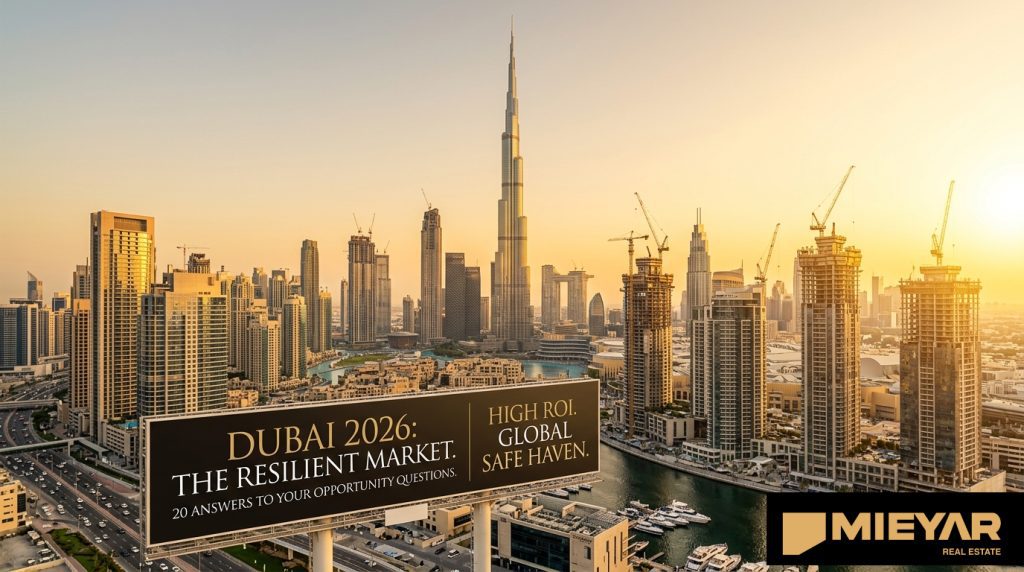
2026 Buying Window
Investor Edition
Dubai Real Estate 2026: The Safe Haven Advantage, 8%+ Yields & Why the Smartest Window in Years Is Open Right Now
Zero tax. World-class infrastructure. A government built for growth. While the headlines create noise, Dubai’s fundamentals create wealth. A licensed mortgage consultant answers the 20 questions every serious investor is asking in 2026 — and every answer points in the same direction.
Dubai Mortgage Insider — MIEYAR UAE
Licensed Mortgage Consultant · Published March 2026 · 10 min read
Part I: The Safe Haven Advantage
There is a reason the world’s most mobile capital keeps finding its way to Dubai. It is not luck, not geography, and not a temporary trend. It is the result of decades of deliberate, disciplined nation-building by a government that understands exactly what international investors and residents need — and has systematically built every piece of that infrastructure.
In 2026, that infrastructure is more powerful than ever. And for investors watching from the sidelines, the message from every data point in this market is the same: the window is open, and it will not stay this way for long.
“Geopolitical noise is temporary. Dubai’s fundamentals — zero tax, world-class safety, and unstoppable infrastructure — are permanent. The question in 2026 is not why Dubai. It is why wait.”
Is Dubai still the world’s safest place for capital?
- Absolutely. Dubai operates as genuine neutral ground — diplomatically, financially, and physically. The UAE’s stability is a deliberate, decades-long achievement backed by world-class defence infrastructure and a government with both the resources and the will to protect its residents and their assets.
- Capital continues to flow here precisely because safety is not marketed as a feature in Dubai — it is delivered as a standard. From Downtown to Dubai South, every community in this city is built on a foundation of security that most global cities can only aspire to.
How does the UAE’s neutrality protect my investment?
- The UAE’s diplomatic neutrality — widely described as the Switzerland of the Middle East model — ensures that business, trade, and tourism continue uninterrupted regardless of what is happening in the wider region. This approach keeps the economy insulated and property values protected through cycles that would damage less strategically positioned markets.
- This neutrality is not passive. It is actively maintained through relationships with every major global power, trade partnerships across six continents, and an economic diversification strategy that means no single sector — including real estate — is ever the sole load-bearing pillar of the UAE economy.
Why is this moment being called a once-in-a-cycle buying window?
- Market pauses are historically where the most wealth is created. When sentiment softens and hesitation creates a temporary supply-demand imbalance, prepared buyers gain negotiating power they have not had during the full-price frenzy of the preceding cycle.
- Smart money does not see the current atmosphere as a risk. It sees a rare chance to secure prime units with better terms, more motivated sellers, and entry prices that the next wave of demand will quickly erase. Every major rebound in Dubai’s history has rewarded exactly this type of conviction buyer.
Is the Golden Visa still the best residency play in 2026?
- Without question. The 10-year Golden Visa remains the global gold standard for residency-by-investment — offering 100% property ownership, a completely tax-free lifestyle, and a quality of life that no comparable programme in Europe, Asia, or the Americas can match at this price point in 2026.
- For investors and their families, the Golden Visa is not just a residency document. It is a platform for generational wealth — anchoring assets, business activities, and family life in one of the world’s fastest-growing and most globally connected cities, with the security of a long-term legal status that travels with you.
Part II: Market Strength, Yields & ROI
The numbers tell a story that no amount of geopolitical noise can obscure. Dubai’s real estate market in 2026 is a yield machine backed by structural demand, currency stability, and a regulatory framework that protects investors at every step. Let the data speak.
Will property prices continue rising in 2026?
- The overall trajectory remains firmly upward. While some secondary areas are absorbing supply and stabilising — which is healthy for long-term market integrity — prime areas are seeing sustained demand that outpaces available stock. Growing population, limited supply in iconic addresses, and continued foreign capital inflows all point in one direction.
- Palm Jebel Ali is the standout story. The combination of a globally recognised brand, genuinely constrained supply, and a buyer profile drawn from the world’s most affluent communities creates an appreciation dynamic that is as close to a structural certainty as real estate markets produce.
Is “buy the dip” the right strategy right now?
- History answers this definitively. In every previous period of Dubai “wait-and-watch” sentiment — 2009, 2016, 2020 — the buyers who moved during the pause captured the most significant gains when the market accelerated. 2026 is providing that entry point again, and the structural backdrop — low leverage, strong yields, government support — makes it arguably the cleanest version of that opportunity yet.
- The USD-pegged Dirham adds another layer of protection. In a world of currency volatility, every Dubai property purchase is effectively a dollar-denominated asset — providing a currency stability floor that investors in Euro, Sterling, or Rupee-priced markets simply do not have.
Are luxury villas the best-performing asset class?
- Villas have demonstrated extraordinary resilience through every market event of the past five years, earning the description war-proof in investment circles. The demand for privacy, space, and community has only deepened with time — and the supply of genuinely premium villa stock in Dubai’s best communities is tightly constrained relative to the pipeline of incoming HNW buyers.
- Dubai Hills and Al Barari are the benchmark examples: communities where demand from global UHNW buyers consistently outpaces availability, where prices have moved significantly through every cycle, and where the 24 to 36 month appreciation outlook is among the strongest in the entire Gulf region.
Part III: Developer Confidence & Off-Plan Safety
One of Dubai’s most underappreciated competitive advantages is the sophistication of its real estate regulatory framework. RERA — the Real Estate Regulatory Authority — has spent the past decade building a developer accountability structure that makes Dubai off-plan investment one of the safest propositions available in any global market.
Are construction projects still on track?
- Major developers including Emaar and Binghatti have confirmed that all sites remain fully operational. Dubai’s construction ecosystem is built for speed and continuity — and the 2026 delivery pipeline is on schedule. For buyers with projects in progress, the timeline certainty that Dubai’s top developers provide is a genuine differentiator from any comparable emerging market.
- The competition among developers in 2026 is producing something remarkable for buyers: new properties are integrating AI building management, green technology, and sustainable design at a pace that means modern Dubai stock is appreciating in quality as well as price — protecting long-term hold value in ways that older inventory simply cannot match.
Is off-plan still a safe investment in 2026?
- Thanks to RERA’s mandatory escrow regulations, your capital in a Dubai off-plan project is legally ring-fenced and protected from day one. Developer funds are held in regulated escrow accounts and can only be released against verified construction milestones — a level of buyer protection that exceeds most mature Western real estate markets.
- Buying off-plan in Dubai from an established developer is not just a property transaction — it is the acquisition of a regulated financial asset in a market that has spent a decade strengthening the rules that protect it. The investor who understands this is not taking risk. They are managing it with extraordinary precision.
Are developers offering better incentives right now?
- Yes — and the current incentive environment is among the most favourable seen in years. DLD waiver programmes, post-handover payment plans of 60/40 and 70/30, and extended payment schedules are giving buyers the ability to build significant property portfolios with substantially less upfront capital than the same assets required 18 months ago.
- For portfolio builders — investors looking to acquire multiple assets rather than a single unit — the current incentive environment combined with competitive mortgage structures creates compounding leverage potential that is genuinely extraordinary. This is the moment to build, not wait.
Part IV: Global Connectivity, Growth & the Areas of Tomorrow
Dubai is not standing still. While some markets are managing decline, Dubai is engineering expansion — in population, infrastructure, connectivity, and global relevance. The areas and assets that benefit from this expansion most directly are where the next generation of wealth will be built.
What does population growth mean for your investment?
- Dubai added over 200,000 residents in a recent period — and every single one of those residents needs housing. Population growth of this scale creates a structural demand floor for property prices that operates regardless of short-term sentiment cycles. You are not just buying a property; you are buying into a city that is actively expanding its own addressable market.
- The composition of this population growth matters as much as the scale. Dubai is attracting the world’s most productive, highest-earning, and most internationally mobile individuals — people who rent and buy at the premium end of the market, who generate the economic activity that supports the commercial and hospitality ecosystems around them, and who create the demand that drives the next cycle of appreciation.
Why are Indian and European investors accelerating their Dubai activity?
- For Indian HNW buyers, the calculus is simple: Dubai offers more for less than any comparable destination. Compared to Mumbai’s high property prices, limited yield, and increasing regulatory complexity, Dubai delivers better yields, stronger capital appreciation, tax-free income, and a quality of life that is genuinely world-class — at prices that still represent exceptional value for this buyer profile.
- European investors — particularly from the UK, Germany, France, and Italy — are accelerating Dubai allocations in response to rising tax burdens, slower growth environments, and the appeal of diversifying into a dollar-backed, high-yield asset outside European regulatory reach. For this community, Dubai is not an alternative. It is increasingly the primary choice.
Which areas will deliver the highest gains by 2027–2028?
- Dubai South and Aviation City: The Al Maktoum International Airport expansion is a generational infrastructure event — set to make Dubai the logistics capital of the world and drive property values in the surrounding Aviation City corridor to levels that early investors will look back on as the clearest opportunity they were ever given. Buyers entering this area now are buying ahead of the most significant infrastructure-driven appreciation story in Dubai’s recent history.
- Dubai Islands: A brand-new coastline being built from scratch with world-class planning, international developer involvement, and a positioning at the ultra-premium end of the market. Early buyers in Dubai Islands are acquiring assets in a community that does not yet fully exist — which is precisely when the highest returns are captured.
- RAK — Al Marjan Island: The Wynn resort is the catalyst that places RAK on the global luxury hospitality and investment map. Pre-Wynn pricing in this area represents one of the most asymmetric investment opportunities in the wider Gulf — the return window for early investors is closing fast as global attention builds.
Part V: The Final Word on Dubai in 2026
Dubai has built something remarkable — a city that does not merely survive global challenges but uses them as a springboard to evolve, attract, and grow. Every disruption in the region’s recent history has ended with more capital in Dubai, more residents choosing Dubai, and more developers building in Dubai.
The fundamentals that underpin this pattern are not accidental. Zero income tax. Zero capital gains tax. A USD-pegged currency. RERA-regulated investment security. Golden Visa residency. World-class healthcare, education, and infrastructure. A government with the fiscal reserves to protect and invest through any cycle. These are permanent structural advantages — and no amount of temporary geopolitical noise changes any of them.
What 2026 has given investors is something rarer: the combination of permanent structural strength and temporary market hesitation. These two things do not often overlap. When they do, the investors who recognise it and act are the ones who define the next cycle.
“Dubai has not just built a great city. It has built a city specifically designed to be the world’s most compelling address for capital, talent, and ambition — and in 2026, it is delivering on every dimension of that promise.”
Your Next Move Starts With One Conversation
Whether you are a first-time buyer, a seasoned portfolio investor, or navigating large existing exposure — our team will give you a precise, data-driven view of your options right now. Conventional mortgages, Islamic financing, expat products, refinancing, off-plan structure — we cover every angle so you can move with complete confidence.
Off-plan mortgage
Expat & non-resident loans
Islamic financing
Portfolio refinancing
Villa purchase mortgage
Frequently Asked Questions
Is Dubai real estate truly tax-free in 2026?
Yes. There is zero income tax, zero capital gains tax, and zero inheritance tax on Dubai property. Rental income is yours to keep entirely. Combined with the USD-pegged Dirham providing currency stability, Dubai offers a net return profile that no major Western property market comes close to matching.
What rental yields can I realistically expect in Dubai in 2026?
Long-term rental yields in high-demand areas like JVC and Dubai Marina are consistently delivering 8 percent and above. Short-term rental yields through well-managed Airbnb-style operations in tourist-focused zones are reaching 10 to 12 percent. These are gross figures — net yields after fees and vacancy remain well above comparable global cities even after costs.
How safe is off-plan investment in Dubai?
RERA’s mandatory escrow framework means your capital is legally protected from the moment you purchase. Developer funds are held in regulated accounts and released only against verified construction milestones. Buying off-plan from an established Dubai developer offers a level of regulatory protection that exceeds most mature Western markets — and the current incentive environment makes the financial terms more favourable than they have been in years.
Which new Dubai areas offer the highest growth potential for 2027–2028?
Dubai South and Aviation City — driven by the Al Maktoum Airport expansion — represent the single largest infrastructure-linked appreciation opportunity in Dubai’s current pipeline. Dubai Islands offers a premium coastal play at early-entry pricing. RAK’s Al Marjan Island, ahead of the Wynn opening, is one of the most compelling pre-catalyst opportunities in the wider Gulf region right now.
Is the Golden Visa still worth pursuing through property investment?
Absolutely. The 10-year Golden Visa tied to property ownership remains the world’s most valuable residency-by-investment programme at its price point. It provides 100% ownership rights, long-term legal residency for you and your family, and access to a tax-free lifestyle in one of the world’s most globally connected cities — all from a single qualifying property purchase.
Why are Indian investors the most active buyer group in Dubai property?
Dubai delivers a combination that simply does not exist elsewhere for Indian HNW buyers: higher yields than Mumbai, stronger capital appreciation, zero tax on income and gains, a USD-backed currency, Golden Visa residency, and a cultural familiarity built over decades. The community of successful Indian entrepreneurs and executives choosing Dubai as their primary or secondary base is growing every year — and their preferred investment zones are precisely the areas with the strongest forward fundamentals.
How does the Al Maktoum Airport expansion affect nearby property values?
The DWC expansion is one of the most significant infrastructure events in Dubai’s modern history — designed to make the city the global logistics capital and eventually the world’s busiest airport. Properties in Dubai South and Aviation City are positioned to benefit from the same price appreciation dynamic that properties near Dubai International Airport experienced in the decade following its major expansions. Early entry in this corridor is a generational opportunity.
This article reflects the perspective of a Dubai-based licensed mortgage consultant as of March 2026 and is intended for informational purposes only. It does not constitute financial, legal, or investment advice. Property markets involve risk and individual circumstances vary — please consult a qualified professional before making any property or financing decisions. For personalised mortgage guidance, visit mieyaruae.com.



 English
  العربية