
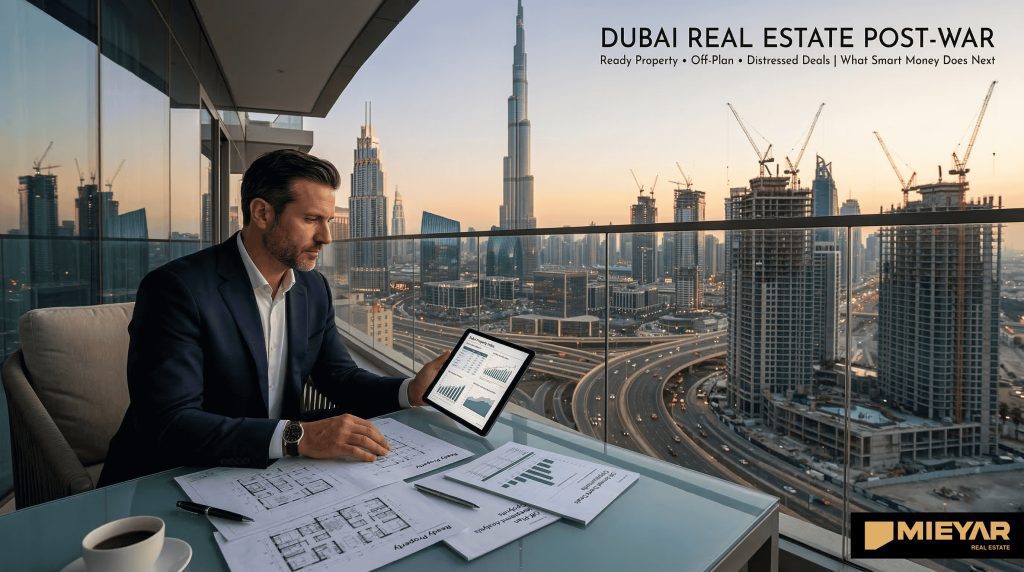
Post-War Opportunity
March 2026
Dubai Real Estate Post-War 2026: Why the Best Buying Opportunity in Years Is Opening Right Now
Every cycle turns. Every period of uncertainty eventually gives way to clarity — and with clarity comes capital. A Dubai mortgage consultant breaks down exactly where the opportunities are, which areas lead the recovery, and why the investors moving now will look very smart in 24 months.
Dubai Mortgage Insider — MIEYA UAE
Licensed Mortgage Consultant · Published March 2026 · 9 min read
Every Great Dubai Cycle Has Started Exactly Like This
Post-COVID. Post-2014 oil correction. Post every regional flare-up of the past two decades. The pattern is always the same: a period of hesitation, a window of opportunity, and then a wave of capital that rewards those who moved while others waited. We are standing at the beginning of that wave right now.
The fundamentals that made Dubai one of the world’s most compelling real estate markets did not change during the conflict. Yields of 5 to 7 percent in prime zones. A government with the fiscal reserves and the political will to protect its real estate ecosystem. A Golden Visa programme that continues to attract the world’s most mobile and ambitious individuals. An infrastructure pipeline that has not paused for a single day.
What the conflict created — briefly — was hesitation. And hesitation, for a prepared and long-term-focused buyer, is simply another word for entry point.
“The investors who will look back at 2026 with the most satisfaction are the ones who understood that uncertainty is not a reason to pause — it is the reason to prepare, act, and position ahead of the rebound.”
Ready Property: Immediate Yield, Immediate Opportunity
Why ready property shines right now
- Ready property delivered its promise through the conflict period. Occupancy in well-located units held firm, yields remained strong, and owners who held their positions are in an excellent place as confidence returns to the market.
- Sellers who paused listings during peak uncertainty are now re-entering — creating a brief, genuine window of increased supply and negotiating leverage that buyers have not seen in over two years. This is a gift to prepared buyers and it will not last long.
- For investors seeking immediate cash flow, ready property is the most direct path. Rental income from day one, no completion risk, and the ability to refinance against existing equity as values recover creates a powerful compounding dynamic.
- Prime areas that demonstrated resilience — Palm Jumeirah, Downtown Dubai, Dubai Hills, and Jumeirah Village Circle — are set to absorb renewed demand fastest as the market reopens. Buyers entering these zones now are securing assets ahead of the price firming that follows every post-uncertainty rebound.
Off-plan: the strategic long-game is wide open
- Off-plan from Dubai’s established tier-one developers — Emaar, Aldar, Sobha, Nakheel — remains one of the most powerful wealth-building tools available to investors in this city. Government-backed, structurally sound, and delivering into a demand environment that is only growing.
- The secondary market for off-plan units is offering something rare right now: below-launch-price entry into projects from the city’s strongest developers, from sellers who need liquidity. Tier-one quality at tier-two pricing is not a common occurrence — and it will not persist past the confidence recovery.
- Payment plan structures from major developers remain exceptionally favourable — often 60/40 or 70/30 post-handover arrangements that allow investors to acquire significant assets with relatively modest upfront capital. Combined with a well-structured mortgage, the leverage dynamics are compelling.
- Dubai’s off-plan supply pipeline is one of the most transparent and government-regulated in the world. RERA escrow requirements mean developer funds are ring-fenced and protected. Buying off-plan in Dubai from an established developer is a structurally safer proposition than in almost any comparable global market.
The Areas Leading the Recovery — and Why
Not all areas move at the same pace coming out of an uncertainty period. Here are the zones our consultants are most excited about right now, and the specific reasons why each one has a compelling forward story.
Villas: The Single Strongest Appreciation Story in Dubai Right Now
If there is one asset class that post-conflict dynamics have made more attractive — not less — it is the Dubai villa. Here is the logic, and it is straightforward.
The conflict accelerated a trend that was already firmly in motion: ultra-high-net-worth individuals and affluent families who were considering Dubai as a base are now actively relocating rather than simply exploring. Political complexity in the wider region, however temporary, is precisely the reminder this cohort needed of why they wanted a stable, well-governed, world-class city as their anchor.
That cohort buys villas. Gated communities with school access, green corridors, proximity to business districts, and the privacy that comes with land ownership. Dubai Hills, Arabian Ranches, Jumeirah Golf Estates, Damac Hills, and Palm villas are all direct beneficiaries — and the supply of genuinely premium villa stock in these communities is tightly constrained relative to the demand pipeline that is building.
For villa holders: your patience has created significant equity and the 24 to 36 month appreciation outlook is among the strongest in the city. For villa buyers: the next 90 days represent an entry point that is unlikely to repeat in this cycle. Act with conviction.
RAK: A Longer Play With a Very Bright Horizon
Ras Al Khaimah deserves a moment of clarity because the opportunity there is real, well-timed, and underappreciated by the broader market right now.
The Wynn Al Marjan Island resort — set to be the first licensed casino in the UAE — remains on track and is drawing a category of international leisure and hospitality investor that has never previously engaged with the Northern Emirates. The infrastructure investment flowing into RAK from the government is accelerating, not slowing. And the lifestyle proposition — quieter, greener, more spacious, significantly more affordable than Dubai core — is becoming more appealing precisely as Dubai’s prime areas appreciate and price out certain buyer segments.
Short-term sentiment created a pricing softness in RAK that patient investors should be actively exploring. Waterfront and resort-adjacent units from established developers in Al Marjan Island, Al Hamra, and Mina Al Arab represent some of the most asymmetric risk-reward positions currently available in the wider UAE market. The buyers entering these positions now, ahead of the Wynn opening and the global attention it will bring, are the ones who will be telling that story for years.
Which Nationalities Are Entering — and Why It Matters for Your Investment
Understanding buyer flow is one of the most powerful signals available to a property investor. Capital follows people, and the people currently moving toward Dubai represent some of the world’s most affluent and investment-active communities.
The nationalities driving the next wave
- Indian diaspora — the anchor buyer group: Indian HNW and UHNW buyers have been the dominant force in Dubai real estate for three consecutive years and every signal points to this deepening post-conflict. Deep cultural familiarity with Dubai, Golden Visa accessibility, tax efficiency, and direct flight connectivity make Dubai the natural home base for India’s most successful entrepreneurs and executives. This community is expected to account for 30 to 40 percent of high-value transactions over the next 12 months — buy in their preferred zones and you are buying with the current.
- European HNW relocators: UK, German, French, and Italian buyers continue to move capital and residency toward Dubai in response to increasingly complex European tax and regulatory environments. This trend predates the conflict and has not slowed. These buyers target premium ready property and luxury villas — Palm Jumeirah, Dubai Hills, Emirates Hills, and Downtown are their primary zones.
- Russian and CIS buyers: This community has been a consistent and significant force in Dubai since 2022. They are long-term holders, primarily in ready property, and bring substantial capital depth. Their continued presence supports pricing in Marina, JBR, and Business Bay.
- East and Southeast Asian investors: Chinese, Hong Kong, and Singaporean buyers with regional diversification mandates are increasing their Dubai allocations. Dubai’s relative political stability, yield advantage over Asian gateway cities, and time-zone accessibility are all key draws for this group — and they tend to enter at scale when they enter.
- African business community: An underreported but fast-growing buyer segment. Nigerian, Kenyan, South African, and Egyptian HNW buyers are increasingly choosing Dubai as their international asset base — drawn by ease of company formation, lifestyle, and the UAE’s growing trade relationships with the African continent.
The Smart Money Playbook: Distressed Deals and How to Find Them
Every post-uncertainty period produces a set of motivated sellers — and those sellers create opportunity for prepared, liquid, and decisive buyers. This is not about capitalising on misfortune. It is simply how healthy markets rebalance, and it is where the best risk-adjusted returns in this cycle will be found.
- Secondary off-plan resales from motivated holders: Investors who bought in 2023–2024 with short-term plans and now need liquidity are offering units in strong tier-one projects at 8 to 15 percent below original launch price. You get tier-one developer quality at a meaningful discount — one of the cleanest value propositions currently available.
- Quiet ready property deals from departing expats: Some Western corporate expats are choosing to exit at this moment — and their properties, particularly in JBR, Marina, and Palm, are coming to market below peak valuations. The best of these transactions happen off-market through broker relationships, not on Property Finder.
- Perception-softened zones with strong fundamentals: Certain areas experienced price softness driven entirely by proximity perception rather than genuine risk. These are excellent opportunities for buyers who understand the actual risk profile — the price discount is temporary, the fundamentals are not.
- How to access these opportunities: Build active relationships with 3 to 4 specialist brokers in your target zone and ask specifically for off-market and motivated seller opportunities. More importantly — get your mortgage pre-approved now so you can move within days when the right deal surfaces. In this market, the buyer who can close fast wins the best assets.
If You Have Large Exposure Right Now: Your Path Forward Is Clearer Than You Think
Feeling uncertain about large positions is a natural response to a fast-moving market. But uncertainty is not the same as risk — and for most investors with well-located, equity-backed Dubai property, the position is considerably stronger than the current sentiment would suggest.
- Assess by fundamentals, not headlines: Separate each asset by developer strength, location quality, and yield performance. Strong fundamentals across all three markers means your position is solid and the correct strategy is to hold, wait for the rebound, and refinance strategically if cash flow optimisation is needed.
- Use refinancing to create flexibility: If you have equity in ready assets, a refinance can release capital for opportunistic acquisitions without requiring any sales. This is one of the most powerful tools available to investors in a soft market — turning existing equity into future upside.
- Consider this a rebalancing opportunity: If your portfolio has concentration in any single zone or asset type, the current market offers the chance to diversify into areas with strong forward momentum — villa communities, Creek Harbour, or RAK — while the entry pricing is still favourable.
- Act with data, not emotion: Every major decision — hold, buy more, or refinance — should be made with current mortgage market data, lender appetite analysis, and a clear view of your financing structure. This is the exact conversation we have with investors every day at MIEYA UAE. The clarity that comes from a single consultation is worth more than weeks of uncertainty.
Ready to Turn Uncertainty Into Your Competitive Advantage?
The investors who come out of this cycle ahead are the ones who sought clarity early, structured their financing correctly, and moved with conviction while others hesitated. Our team is here to give you exactly that clarity — no pressure, no generic advice, just a precise view of your options and opportunities right now.
Refinancing strategy
Distressed deal financing
Off-plan mortgage
Expat & non-resident loans
Islamic financing
Frequently Asked Questions
Is now a good time to invest in Dubai real estate after the conflict?
For long-term investors, post-conflict windows have historically been the most rewarding entry points in Dubai’s cycles. Pent-up demand, temporarily softened prices, and renewed capital inflows from global HNW buyers create a compelling setup — particularly in prime ready property and secondary off-plan resales from tier-one developers. The buyers entering now are positioning ahead of the rebound.
Which Dubai areas offer the best investment opportunities in 2026?
Palm Jumeirah, Dubai Hills, Creek Harbour, Downtown, and Business Bay offer the strongest combination of yield, resilience, and appreciation potential. For villa buyers specifically, Jumeirah Golf Estates and Arabian Ranches are seeing surging demand from HNW relocation buyers with very limited supply to absorb it — creating strong upward price pressure.
Can I find distressed property deals in Dubai post-war?
Yes — selectively and with the right broker relationships. The best opportunities are secondary off-plan resales from motivated holders and quiet ready property deals from departing expats, most of which never reach public portals. The critical enabler is pre-approved financing — buyers who can move quickly win the best assets. Speak to a mortgage consultant before you start searching, not after you find a deal.
Will Dubai villa prices continue to rise in 2026 and beyond?
The structural case for villa appreciation is strong and has been reinforced by the conflict. HNW relocation demand from global buyers, genuine supply constraints in premium gated communities, and continued infrastructure investment all point toward sustained price growth. Dubai Hills, Palm Jumeirah, and Jumeirah Golf Estates have the most compelling 24 to 36 month outlook in the villa segment.
Is RAK real estate worth investing in after the conflict?
RAK represents one of the most attractive opportunity windows in the wider UAE market right now. The Wynn Al Marjan Island resort remains on track, government infrastructure investment is accelerating, and short-term sentiment softness has created entry prices that are unlikely to persist once global attention returns to the market. Waterfront and resort-adjacent units from established developers are the right position — and the time to take it is now, ahead of the Wynn opening.
Is the Indian diaspora really the biggest buyer group driving Dubai property in 2026?
By transaction value in the luxury and mid-luxury segment, Indian HNW buyers have been the dominant force for several years and this is strengthening. Deep familiarity with Dubai, Golden Visa accessibility, tax efficiency, and geographic proximity make this community the natural anchor buyer — and their preferred zones (Palm Jumeirah, Downtown, Dubai Hills) are precisely the areas with the strongest forward fundamentals.
How do I get a mortgage as a non-resident or expat buying in Dubai in 2026?
Expat and non-resident mortgage products are fully active and competitive. LTV ratios for non-residents typically range from 50 to 75 percent depending on nationality, income profile, and property type. Both conventional and Islamic financing options are available. A mortgage consultant will compare products across lenders, structure the most efficient option for your profile, and — critically — get you pre-approved so you can move decisively when the right opportunity surfaces.
This article reflects the perspective of a Dubai-based licensed mortgage consultant as of March 2026 and is intended for informational purposes only. It does not constitute financial, legal, or investment advice. Property markets involve risk and individual circumstances vary — please consult a qualified professional before making any property or financing decisions. For personalised mortgage guidance, visit mieyaruae.com.


 English
  العربية